
Rolling Bearing Cages – Diversity, Function, and Potential
Rolling bearing cages are an often underestimated yet crucial component in bearing technology. They not only keep the rolling elements evenly spaced and prevent them from coming into contact with one another, but also significantly influence a bearing’s performance, service life, and efficiency. Rolling elements are evenly arranged in a cage and cannot come into contact with one another. In separable designs such as tapered roller bearings and drawn cup needle roller bearings, cages also prevent the rolling elements from falling out.
What types of cages are used in rolling bearing technology?
| Cage Type | Materials | Applications | Key Benefits |
|---|---|---|---|
| Sheet Metal Cages | Steel, brass | Small and medium-sized bearings, high production volumes | Lightweight, cost-effective, space-saving, good lubricant distribution |
| Machined Cages | Brass, steel | Large bearings, low production volumes, stringent running accuracy requirements | Robust, temperature-resistant, high guiding rigidity, good emergency running properties |
| Plastic Cages | Glass-fiber-reinforced plastics (e.g., PA6.6-GF) | Shock loads, acceleration, chemical resistance | Lightweight, good sliding properties, corrosion-resistant |
| Special-Purpose Cages | Special materials, coated materials | Extreme conditions (vibrations, high rotational speeds, corrosion) | Customizable, vibration-resistant, low-friction, wear-resistant |
Here is a graphical overview of the structure of a rolling bearing cage:
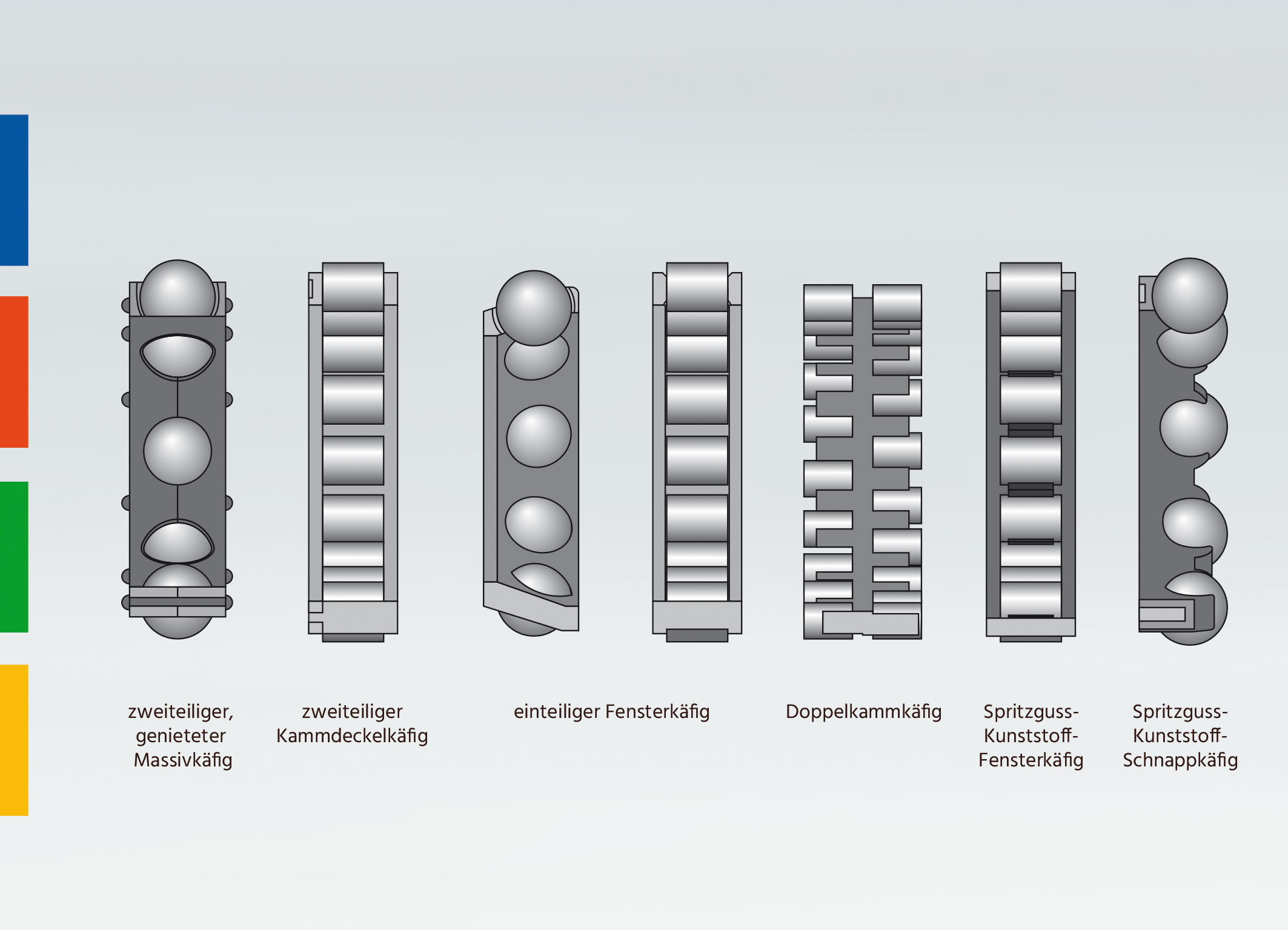
Rolling element-guided, outer ring-guided, inner ring-guided rolling bearing cage
The guidance method of a cage affects friction, running accuracy, and service life:
- : Standard solution with low friction but reduced guidance accuracy.
- : High guidance stiffness, ideal for high speeds, but with increased friction.
- Inner-ring-guided: Lower guidance stiffness and used less frequently because stiffness decreases as speed increases.
What coatings are available?
Coatings improve the mechanical properties of rolling bearing cages—for example, wear protection, friction reduction, or heat dissipation. Common options include DLC (diamond-like carbon), copper/silver for emergency lubrication, or manganese/zinc phosphate to reduce friction. They extend service life and adapt cages to extreme conditions such as high speeds or corrosive environments.
| Coating | Benefits | Applications |
|---|---|---|
| DLC (Diamond-like Carbon) | Extremely hard, wear-resistant, low-friction | High loads, long service life |
| Copper/Silver | Good emergency lubrication, heat dissipation | High speeds, thermal stress |
| Manganese/Zinc Phosphate | Reduces friction, corrosion protection | General wear protection, standard bearings |
| PTFE (Teflon) | Chemically resistant, low-friction | Aggressive environments, dry running |
How can cages extend the service life of rolling bearings?
Riveted cages (e.g., made of sheet steel) are lightweight, cost-effective, and suitable for standard applications such as deep-groove ball bearings. However, they are susceptible to vibrations and high accelerations: The riveted joints can break when rolling elements strike the cage due to inertia—a common problem in dynamic systems such as robotics. Their lower rigidity results in higher friction and reduced running accuracy compared to solid cages.
Solid cages (e.g., made of brass or glass-fiber-reinforced plastic), on the other hand, offer:
- Greater guiding rigidity for precise roller guidance and reduced resistance.
- Better emergency running properties and temperature resistance, ideal for heavy loads or shock loads.
- Disadvantage: Greater weight, which increases centrifugal forces at high rotational speeds.
- Technology

